
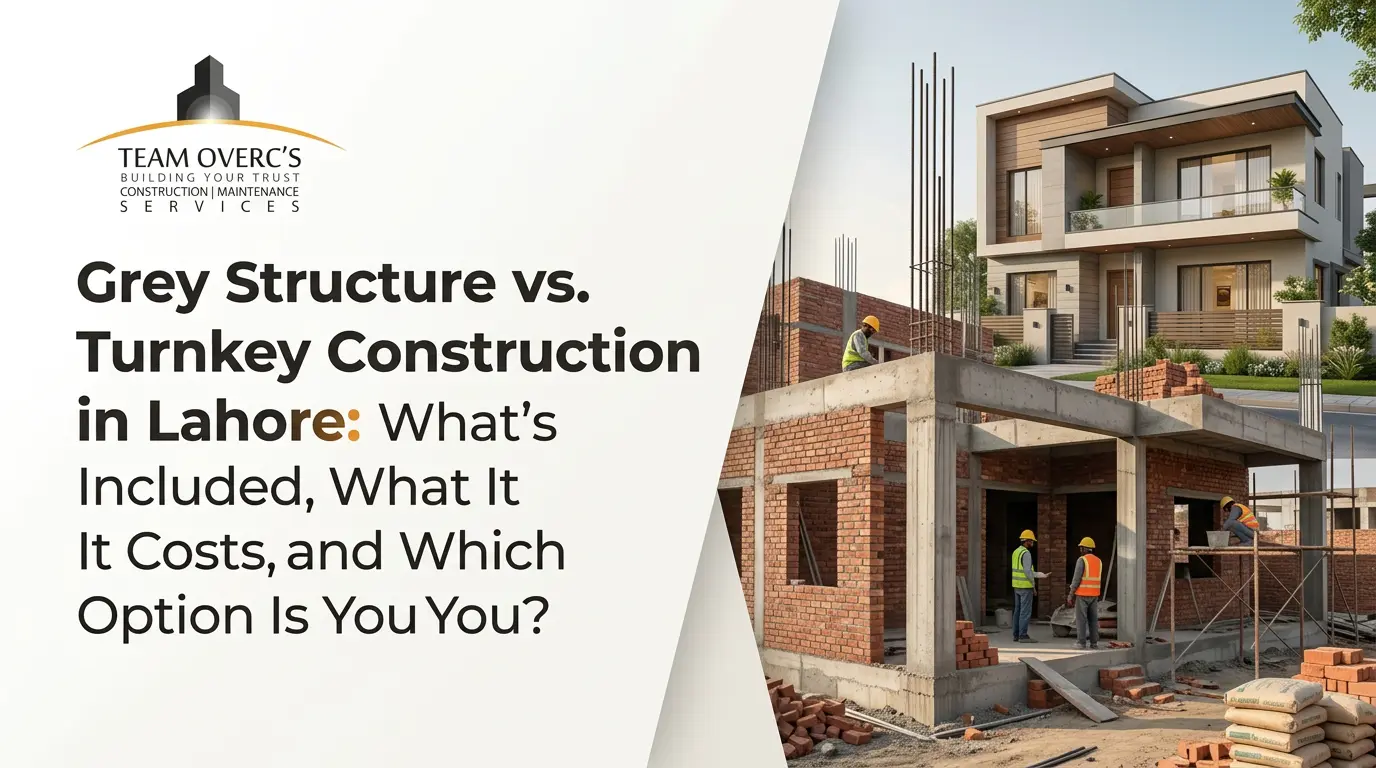
Grey Structure vs. Turnkey Construction in Lahore: What’s Included, What It Costs, and Which Option Is Right for You?
If you’re planning to build a house in Lahore, one of the first decisions you’ll face isn’t about paint colors or tile patterns—it’s about how you want to build. Do you hire a contractor to raise the skeleton of your home and handle finishing yourself, or do you hand the entire project to one company from foundation to final coat of paint?
These two approaches are known as grey structure construction and turnkey construction. Understanding grey structure vs turnkey construction can help you choose the approach that fits your budget, timeline, and level of involvement. Neither option is universally “better”—the right choice depends on your involvement level, your finances, your timeline, and whether you’re building from inside Lahore or managing things remotely.
This guide breaks down what each option actually includes, how costs typically compare, why quotations from different contractors can vary so widely, and how to decide which path suits your situation.
Grey Structure vs Turnkey Construction at a Glance
| Factor | Grey Structure | Turnkey Construction |
| Construction Scope | Structural shell only | Structure + complete finishing |
| Finishing | Not included | Fully included |
| Cost | Lower upfront cost | Higher total cost, paid in stages |
| Owner Involvement | High—you manage finishing separately | Low—one company manages everything |
| Flexibility | High — choose finishing materials and contractors yourself | Lower—finishing is bound to the agreed BOQ |
| Project Management | You coordinate multiple contractors | A single point of contact manages the project |
| Best Suited For | Hands-on owners, phased builders, those with trusted finishing contractors | Overseas Pakistanis, busy owners, those wanting a complete solution |
This table is a starting point, not a substitute for a detailed conversation with your contractor — actual inclusions always come down to the agreement and Bill of Quantities (BOQ) you sign.
What Is Grey Structure Construction?
“Grey structure construction” refers to building the structural shell of a house—the part that gives it strength and form, but without any of the finishing that makes it livable. Once grey structure work is complete, you’re left with a solid, weather-resistant shell: walls standing, floors slabbed, and roof in place—but no tiles, no paint, no fixtures, and no fittings.
It’s called a “grey” structure because that’s essentially what you see: exposed concrete, brick, and cement, without any surface finishing applied over it.
What Is Included in Grey Structure?
While specifics vary by contractor, grey structure construction typically covers:
- Site preparation — clearing, leveling, and marking the plot for construction
- Foundation — excavation and footing work that anchors the building
- Columns and beams — the vertical and horizontal structural framework
- RCC work — reinforced cement concrete work that forms the structural core
- Brickwork — walls built up to define the layout of each floor
- Roof slabs — the poured concrete slabs that form ceilings and rooftops
- Basic electrical and plumbing provisions — conduit and piping laid within walls and floors, without switches, fixtures, or fittings installed
It’s worth stressing: exact inclusions depend on your contractor’s BOQ and the agreement you sign. Some contractors include a bit more (such as plaster), while others stop strictly at the structural shell. Always confirm scope in writing before construction begins.
What Is Turnkey Construction?
Turnkey construction is an end-to-end construction solution—the idea being that once the project is complete, the owner can simply “turn the key” and move in. It covers everything from the first shovel of earth to the final coat of paint, meaning you don’t need to separately hire tile layers, painters, electricians, or plumbers.
For owners who want to minimize hands-on involvement, turnkey construction consolidates the entire build under one contractor and one contract.
What Is Included in Turnkey Construction?
A typical turnkey package builds on a grey structure and adds full finishing work, including
- Grey structure — the complete structural shell, as described above
- Flooring and tiles — installation across all rooms, bathrooms, and common areas
- Paint — interior and exterior finishing
- Doors and windows — supply and installation
- Electrical fixtures — switches, sockets, distribution boards, and lighting points
- Plumbing fixtures — taps, fittings, and sanitary ware
- Kitchen — cabinetry, countertops, and fittings as agreed
- Bathrooms — complete fit-out including tiling and fixtures
- Woodwork — built-in wardrobes, cabinets, and other joinery
- Other agreed finishing work — anything else specified in the contract
As with a grey structure, the exact scope of a turnkey package depends entirely on the contract and BOQ. Two “turnkey” quotes from different companies can differ significantly depending on material brands, finishing quality, and what’s explicitly included or excluded.
Grey Structure vs Turnkey Construction: Key Differences
Cost
Grey structure construction has a lower initial cost because you’re only paying for structural work. However, the total cost of building a house grey-structure-first can end up similar to—or sometimes higher than—turnkey construction, since you’re sourcing finishing materials and labour separately, often without the bulk-purchase advantages a construction company might negotiate.
Turnkey construction carries a higher total contract value, but that cost is usually spread across payment milestones tied to project stages, giving you a clearer, more predictable total from day one.
Owner Involvement
Grey structure construction requires you to take the reins once the shell is complete. You’ll need to hire and coordinate separate teams for flooring, painting, electrical fitting, plumbing, kitchen work, and more—and supervise each of them.
Turnkey construction significantly reduces this burden. One company manages the entire project, meaning fewer people to coordinate, fewer decisions to chase, and far less day-to-day supervision required from you.
Budget Flexibility
Grey structure construction allows for phased spending—you can complete the structure now and finish the interior later, whenever funds allow. This makes it a popular choice for owners who want to spread out costs over months or years.
Turnkey construction requires complete project budgeting upfront. You commit to the full scope and cost at the outset, which offers cost certainty but less room to pause or phase spending.
Time and Project Management
Managing a grey structure project after handover means juggling multiple contractors—a tiler, a painter, an electrician, and a kitchen fabricator each with their own schedule and each needing coordination so their work doesn’t conflict with the next trade’s.
With turnkey construction, one company plans and sequences the entire project, which typically results in a smoother, more predictable timeline with far less coordination effort on your part.
Control Over Materials and Finishes
Grey structure construction gives you maximum control. Once the shell is built, you choose your own tile brand, paint color, fixtures, and finishing contractors; nothing is locked in until you decide.
Turnkey construction offers convenience over control. Materials and finishes are typically defined in the BOQ upfront, so while you still make selections within the agreed scope, you have less flexibility to swap contractors or shop around mid-project.
Grey Structure vs Turnkey Construction Cost in Lahore
One of the most common questions homeowners ask when comparing grey structure vs turnkey construction in Lahore is simply, “What’s the rate per square foot?” The honest answer is that there’s no single fixed number that applies universally construction cost in Lahore depends on several variables:
- Covered area larger builds often have different per-square-foot economics than smaller ones
- Design architectural complexity, number of floors, and structural requirements
- Material quality the grade of cement, steel, bricks, and finishing materials used
- Labor availability and rates, which can shift with the market and season
- Steel and cement requirements — structural design determines how much of each is needed
- Finishing specifications—the difference between standard and premium finishes can be substantial
- Site conditions — soil type, plot accessibility, and existing site challenges
- Location — construction logistics can vary across different areas of Lahore
Rather than anchoring your budget to a rate you’ve heard quoted elsewhere, it’s far more reliable to base your cost estimate on your project’s actual covered area, your specifications, and a detailed BOQ prepared for your specific plot and design.
Why Construction Quotes Differ Between Contractors
It’s common for homeowners to collect three or four quotations and find the numbers vary widely—sometimes by a significant margin—even for what seems like the “same” project. This usually comes down to differences in:
- Material specifications — the grade and type of cement, steel, bricks, and finishing materials
- Quantities — how much material each contractor has estimated for the same design
- Labor scope—how much of the work is quoted as skilled versus unskilled labour
- Finishing quality — standard-grade versus premium-grade finishes
- Included/excluded items—one quote might include kitchen cabinetry while another excludes it entirely
- Brand specifications—named brands for tiles, sanitary ware, and fittings versus unspecified “equivalent” alternatives
- Project requirements — site-specific factors that affect one project but not another
Key takeaway: Don’t compare contractors on price per square foot alone. Compare the complete BOQ and scope of work. A lower rate that excludes major items isn’t actually a lower cost — it’s an incomplete quote.
What Should You Check in the BOQ?
The Bill of Quantities (BOQ) is the single most important document in any construction agreement — it’s what turns a verbal estimate into a concrete, enforceable scope of work. Before signing anything, check that the BOQ clearly specifies:
- Material quantities — how much of each material is allocated to the project
- Material brands/specifications — named brands or equivalent-quality standards
- Labor—scope of skilled and unskilled labour included
- Electrical work — wiring, points, fixtures, and fittings covered
- Plumbing—pipework, fixtures, and sanitary ware included
- Flooring — tile types, grades, and coverage areas
- Paint — interior/exterior coverage and paint grade
- Doors and windows — materials, sizes, and quantities
- Kitchen and woodwork — cabinetry, countertops, and joinery scope
- Exclusions — items explicitly not covered by the contract
- Payment milestones — how payments are structured against project stages
- Variation policy — how additional costs or changes are handled mid-project
- Project timeline — expected duration and stage-wise deadlines
A detailed, well-documented BOQ protects both you and the contractor—it’s your best defense against cost surprises later in the project.
Which Option Is Better for Overseas Pakistanis?
For Pakistanis living abroad, turnkey construction is often the more practical choice—and for good reason. Building a house from another country makes hands-on supervision genuinely difficult, and grey structure construction’s biggest advantage (owner control) becomes a burden when you can’t physically visit the site.
Turnkey construction addresses several challenges that overseas owners commonly face:
- Remote communication—a single point of contact simplifies staying updated, rather than juggling calls with multiple tradespeople
- Progress updates — established construction companies typically provide structured updates, photos, or reports
- Material approvals — decisions on finishing materials can be handled through a defined process rather than in-person site visits
- Site monitoring — a dedicated project team monitors day-to-day work on your behalf
- Payment milestones — clear, stage-based payments make remote financial planning easier
- Project coordination—one company managing every trade removes the need to coordinate contractors across time zones
For owners who can’t visit Lahore regularly, this consolidation of responsibility often outweighs the loss of hands-on control.
When Should You Choose Grey Structure Construction?
Grey structure construction tends to suit homeowners who
- Want to build in phases, spreading cost over a longer period
- Prefer greater control over materials, finishes, and contractors
- Can personally supervise the project or delegate to someone who can
- Want to select finishing materials themselves rather than relying on a contractor’s choices
- Already have trusted finishing contractors they’ve worked with before
When Should You Choose Turnkey Construction?
Turnkey construction tends to suit homeowners who:
- Have limited time to dedicate to project supervision
- Want to work with one construction team rather than several
- Live outside Lahore
- Are overseas Pakistanis managing the project remotely
- Prefer easier, more centralized project coordination
- Want a complete construction solution from foundation to move-in
Grey Structure vs. Turnkey: Which One Is Right for You?
If you’re still comparing grey structure vs turnkey construction, a simple framework can help:
Choose Grey Structure if control over materials, finishing contractors, and phased spending are your top priorities—and you have the time and willingness to manage multiple trades yourself.
Choose Turnkey if convenience, coordination, and complete project management matter more to you than hands-on control — particularly if you’re short on time or based outside Lahore.
There’s no wrong answer here—only the answer that fits your circumstances, your schedule, and how involved you want (or are able) to be in the day-to-day of construction.
Questions to Ask a Construction Company Before Signing
Whichever route you choose, asking the right questions upfront can save significant cost and stress later:
- What is included in the BOQ?
- Which materials and brands will be used?
- What is excluded from the quotation?
- How are additional costs handled?
- What are the payment milestones?
- What is the expected completion timeline?
- Who will supervise the project?
Getting clear, written answers to these questions before signing anything is the single best way to avoid disputes and budget overruns later in the project.
Final Takeaway
Grey structure and turnkey construction represent two fundamentally different ways of building a home in Lahore—one built around control and phased spending, the other around convenience and complete project management. Neither is inherently cheaper or better; the right choice depends on how much time you can dedicate to supervision, how you want to manage your budget, and whether you’re building from within Lahore or from abroad.
Whichever path you choose, the details that matter most aren’t the headline rate per square foot — they’re the scope, the BOQ, the materials, and the project management structure behind the quote. Compare contractors on substance, not just price, and you’ll be far better positioned to build a house that matches both your budget and your expectations.
Frequently Asked Questions
What is the difference between grey structure vs turnkey construction?
Grey structure construction covers only the structural shell of a house—foundation, columns, beams, brickwork, and roof slabs—without any finishing work. Turnkey construction covers the entire project, from structure through to complete finishing, fixtures, and fittings, so the house is ready to move into.
Is grey structure cheaper than turnkey construction in Lahore?
The upfront cost of grey structure construction is lower since it excludes finishing. However, once you add the cost of finishing separately, the total project cost can end up comparable to, or in some cases higher than, a turnkey package—depending on how efficiently the finishing work is managed.
What is included in grey structure construction?
Site preparation, foundation work, columns and beams, RCC work, brickwork, roof slabs, and basic electrical and plumbing provisions. Exact inclusions depend on the contractor’s BOQ.
What is included in turnkey construction?
Everything in the grey structure, plus flooring and tiles, paint, doors and windows, electrical and plumbing fixtures, kitchen, bathrooms, woodwork, and any other finishing work agreed upon in the contract.
Can I complete the grey structure first and finish the house later?
Yes. This is a common and practical approach for owners who want to spread construction costs over time. Many homeowners complete the grey structure, then finish the interior in phases as budget allows.
How do I compare construction quotations in Lahore?
Don’t compare based on price per square foot alone. Review the complete BOQ for each quotation—material specifications, quantities, labour scope, finishing quality, and any exclusions—before comparing costs.
What should a construction BOQ include?
Material quantities and specifications, labour scope, electrical and plumbing details, flooring and paint specifications, doors and windows, kitchen and woodwork scope, exclusions, payment milestones, variation policy, and project timeline.
Is turnkey construction suitable for overseas Pakistanis?
Yes, turnkey construction is generally well-suited for overseas Pakistanis since it consolidates project management under one company—simplifying remote communication, progress updates, and site supervision that would otherwise be difficult to manage from abroad.
Why do construction costs vary between contractors?
Costs vary due to differences in material specifications, quantities, labour scope, finishing quality, included or excluded items, brand specifications, and project-specific requirements.
Should I choose a grey structure or turnkey construction?
It depends on your priorities. Choose a grey structure if you want control over materials and contractors and prefer phased spending. Choose turnkey if you want convenience, a single point of contact, and complete project management—particularly if you have limited time or live outside Lahore.