

What Should Be Included in a House Construction BOQ? A Homeowner’s Complete Checklist
Building a house is one of the biggest financial decisions most people will ever make, and one of the most overlooked documents in that process is the Bill of Quantities (BOQ). A BOQ is the document that translates your architectural drawings into a detailed list of materials, quantities, labour, and costs. Without it, homeowners are essentially trusting a contractor’s word rather than a documented scope of work.
Before signing any construction agreement, homeowners should insist on reviewing a proper house construction BOQ. It’s the single best tool for understanding exactly what you’re paying for, comparing quotations from different contractors, and avoiding disputes once construction is underway. This guide breaks down what a complete BOQ should include, how to read one, and the mistakes to avoid when evaluating a contractor’s proposal.
What Is a BOQ in House Construction?
A bill of quantities is a structured document that lists every material, quantity, and labour component required to complete a construction project, item by item. It’s the link in a chain that runs from design to execution:
Drawings → Quantities → Materials → Labour → Costs → Construction Scope
Once architectural and structural drawings are finalized, a BOQ breaks those drawings down into measurable units — how many cubic feet of concrete, how many square feet of tiling, how many running feet of wiring, and so on. Each item is then priced to arrive at a total project cost.
It’s worth distinguishing a BOQ from two other documents homeowners commonly encounter:
- BOQ — defines the technical scope: what work will be done and in what quantity.
- Construction Quotation — attaches pricing to that scope, giving a commercial offer.
- Construction Contract — the legal agreement that binds both parties to the scope, price, and terms.
A well-prepared house construction BOQ should form the technical backbone that both the quotation and the contract are built around. If these three documents don’t align, it’s a warning sign.
Why Is a BOQ Important for Homeowners?
Many homeowners skip past the BOQ and go straight to comparing final prices—this is one of the most common and costly mistakes in residential construction. A detailed BOQ matters because it helps you:
- Understand what you’re actually paying for, item by item, rather than accepting a single lump-sum figure
- Compare contractor quotations on equal terms instead of comparing unrelated scopes
- Identify missing work before it becomes an expensive surprise mid-project
- Control your construction budget by knowing where money is allocated
- Reduce misunderstandings between you and the contractor
- Track material quantities so you can verify usage on-site
- Understand inclusions and exclusions clearly, rather than assuming
- Manage changes during construction with a documented baseline to compare against
In short, a house construction bill of quantities is your primary reference point throughout the build — not just a document you glance at before signing.
What Should a House Construction BOQ Include?
A complete BOQ should cover every stage of construction, from the ground up to the final finishes. Below is a full breakdown of what to expect.
Site Preparation and Earthwork
This is the foundation of the foundation—literally the first physical work done on site. It should include:
- Site clearing
- Excavation
- Earth filling
- Soil-related work
- Levelling
- Disposal of excess soil
Foundation Work
The foundation section should be one of the most detailed parts of the BOQ, since it determines the structural integrity of the entire house:
- Footings
- Plain Cement Concrete (PCC)
- Reinforcement steel
- Concrete
- Foundation walls
- Damp-proofing
- Backfilling
Structural Work
This covers the skeleton of the house:
- Columns
- Beams
- RCC slabs
- Staircase
- Reinforcement steel
- Shuttering/formwork
Brickwork and Masonry
Masonry work defines the walls and internal layout of the house:
- External walls
- Internal walls
- Partition walls
- Mortar
- Plaster
Roofing and Waterproofing
Roofing and waterproofing are frequently under-specified in basic quotations, so this section deserves close attention:
- Roof slab
- Waterproofing
- Roof insulation, where applicable
- Drainage provisions
Electrical Work
Electrical scope should go well beyond “wiring included”:
- Wiring
- Conduits
- Switches
- Sockets
- Lighting points
- Distribution boards
- Electrical load requirements
- Backup/solar provisions, where applicable
Plumbing and Sanitary Work
Plumbing work should be itemized separately for supply and drainage systems:
- Water supply pipes
- Drainage
- Sewerage
- Water tanks
- Bathroom plumbing
- Kitchen plumbing
- Sanitary fittings
Flooring and Wall Finishes
Finishing items are often where budgets quietly expand, so quantities and specifications matter here more than almost anywhere else:
- Floor tiles
- Wall tiles
- Marble/stone, where applicable
- Skirting
- Adhesives
- Grouting
Doors and Windows
- Main entrance door
- Internal doors
- Aluminium/uPVC windows
- Glass
- Frames
- Hardware
- Locks
Painting and Decoration
- Surface preparation
- Putty
- Primer
- Interior paint
- Exterior paint
- Waterproof/exterior coatings
Kitchen and Woodwork
- Kitchen cabinets
- Countertops
- Wardrobes
- TV units
- Shelving
- Other built-in furniture
Bathroom Fixtures
- Toilets
- Washbasins
- Faucets
- Showers
- Mirrors
- Accessories
- Shower enclosures, where applicable
External Works
- Boundary wall
- Main gate
- Driveway
- Outdoor flooring
- Landscaping
- External lighting
- Water/sewer connections
A residential construction BOQ that skips any of these sections — even ones that seem minor, like external works — leaves room for costs to appear later that weren’t part of the original agreement.
What Information Should Each BOQ Item Contain?
Listing a material by name alone isn’t enough to make a BOQ useful. Each major item should ideally specify:
- Description of work
- Unit of measurement
- Quantity
- Material specification
- Brand/grade, where relevant
- Labour scope
- Rate
- Total amount
- Location/application
- Inclusions
- Exclusions
Example:
Instead of a vague single line like
Tiles — Rs. X
A properly detailed BOQ should clarify something closer to
Flooring tiles—[specified size and quality]—[quantity]—material rate—installation/labor—applicable areas
This level of detail is what allows homeowners to understand exactly what a quotation covers, rather than discovering gaps once installation begins.
BOQ vs. Construction Quotation: What Is the Difference?
Homeowners often use these two terms interchangeably, but they serve different purposes:
| BOQ | Construction Quotation |
| Lists work and quantities | Provides pricing for the proposed work |
| Defines technical scope | Shows the commercial offer |
| Helps measure materials/work | Helps calculate project cost |
| Used for comparison and control | Used for pricing and agreement |
A construction quotation vs. BOQ comparison should always show alignment—the quotation’s pricing should map directly onto the BOQ’s quantities and specifications. If a quotation exists without a corresponding BOQ, there’s no way to verify what the price is actually based on.
BOQ Checklist Before Hiring a Construction Company
Before signing with any contractor, run their BOQ through this checklist:
- [ ] All construction stages are listed
- [ ] Quantities are specified
- [ ] Materials are clearly described
- [ ] Brands/specifications are mentioned where necessary
- [ ] Labour is clearly defined
- [ ] An electrical scope is included
- [ ] Plumbing scope is included
- [ ] Finishing items are listed
- [ ] External works are addressed
- [ ] Exclusions are clearly stated
- [ ] Payment milestones are defined
- [ ] Variation/change procedure is explained
- [ ] Completion timeline is specified
- [ ] Warranty/defect responsibilities are documented where applicable
If a contractor is reluctant to provide a BOQ this detailed, treat it as a red flag rather than a formality to skip.
Common BOQ Mistakes Homeowners Should Avoid
Comparing Only the Final Price
A cheaper quotation may simply have fewer inclusions. Without comparing scope, a “lower” price can end up costing more once missing items are added back in.
Ignoring Quantities
The same material rate means very little if the quantities behind it differ between contractors. Always compare rate and quantity together.
Accepting Vague Material Descriptions
Terms like “premium quality” or “standard finish” are not specifications—they’re marketing language. Ask for exact brands, grades, or technical standards.
Overlooking Exclusions
Always ask what is not included. Exclusions are often where unexpected costs come from later.
Not Checking Finishing Items
Small finishing items—skirting, grouting, hardware, accessories—can seem minor individually but add up to a meaningful cost difference across a project.
Not Matching the BOQ With Drawings
The BOQ should correspond directly with the approved design and construction requirements. A mismatch between drawings and BOQ quantities usually signals an inaccurate estimate.
Making Verbal Changes
Any change to scope, material, or design during construction should be documented and reflected in project records — not agreed to verbally and forgotten.
How to Compare Two House Construction BOQs
When evaluating quotations from multiple contractors, use a structured, step-by-step process rather than jumping straight to the total:
- Compare the scope of work
- Compare quantities
- Compare material specifications
- Compare brands/grades
- Compare labour inclusions
- Check exclusions
- Check payment terms
- Check variation costs
- Compare timelines
- Compare the final total
Key takeaway: The best quotation is not necessarily the one with the lowest total—it’s the one with the clearest and most comparable scope. A low number attached to a vague BOQ is a bigger risk than a higher number attached to a detailed one.
What Should Homeowners Ask Before Approving a BOQ?
Before giving final approval, homeowners should be able to answer these questions:
- Are all construction stages included?
- Are material quantities specified?
- Which brands or specifications are included?
- Is labour included?
- What items are excluded?
- How are price changes handled?
- How are design changes charged?
- Are external works included?
- What are the payment milestones?
- What happens if the actual quantity differs from the BOQ?
If any of these questions can’t be answered directly from the document in front of you, it’s worth going back to the contractor before signing anything.
BOQ for Overseas Pakistanis Building a House in Lahore
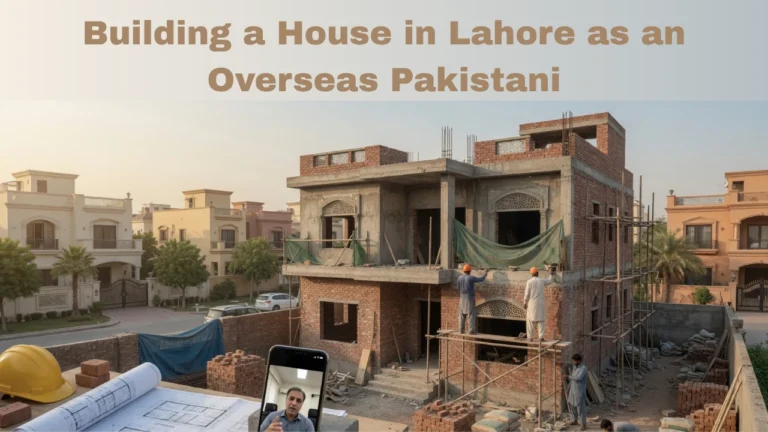
For overseas Pakistanis managing a construction project from abroad, a detailed construction BOQ that Lahore contractors provide is even more critical than for someone who can visit the site regularly. When you can’t personally inspect progress week to week, the BOQ becomes your main tool for remote oversight. A thorough BOQ supports:
- Clear material specifications that leave less room for substitution without approval
- Defined quantities that make it easier to verify against site photos or videos
- Documented costs that prevent informal renegotiation mid-project
- Progress tracking against a fixed scope
- Structured approval of any changes, rather than verbal agreements over a call
- Easier remote communication with contractors, since both sides are referencing the same document
- Better contractor accountability, since deviations from the BOQ are easy to identify
For overseas clients in particular, a vague or incomplete BOQ isn’t just inconvenient — it removes the primary safeguard available when you can’t be on-site to catch issues as they happen.
Final Checklist: Is Your BOQ Detailed Enough?
Here’s a quick test. If you can answer these five questions directly from your BOQ, it’s detailed enough to work from with confidence:
- What work is being done?
- How much work/material is required?
- What specification or quality is being used?
- What does it cost?
- What is excluded?
If any of these five questions leave you guessing, it’s worth requesting a revised, more detailed BOQ before construction begins—not after.
Frequently Asked Questions
What is a BOQ in house construction?
A Bill of Quantities is a document that lists all the materials, quantities, and labour required to complete a construction project, forming the technical basis for pricing and contracts.
What should be included in a house construction BOQ?
It should cover every stage of construction—site preparation, foundation, structural work, masonry, roofing, electrical, plumbing, finishes, doors and windows, painting, kitchen/woodwork, bathroom fixtures, and external works.
Why is a BOQ important when building a house?
It helps homeowners understand costs, compare contractor quotations fairly, control their budget, and avoid disputes over scope during construction.
What is the difference between a BOQ and a construction quotation?
A BOQ defines the technical scope and quantities of work, while a quotation attaches pricing to that scope. The two should always align.
How do I check a construction BOQ?
Verify that it includes all construction stages, specific quantities, clear material specifications, labour scope, and stated exclusions.
How can I compare two construction BOQs?
Compare scope, quantities, specifications, brands, labour inclusions, exclusions, payment terms, variation costs, and timelines before comparing the final total.
Does a BOQ include labour costs?
A complete BOQ should clearly state whether labour is included for each item, rather than bundling it vaguely into a material rate.
Should material brands be mentioned in a BOQ?
Yes, wherever relevant. Naming brands or grades removes ambiguity and prevents substitution with lower-quality alternatives during construction.
Can a BOQ change during construction?
Yes, but changes should always be documented through a formal variation process rather than agreed upon verbally.
What should homeowners check before signing a construction contract?
Homeowners should confirm the BOQ, quotation, and contract all align in scope, quantities, and pricing and that exclusions and payment milestones are clearly stated.