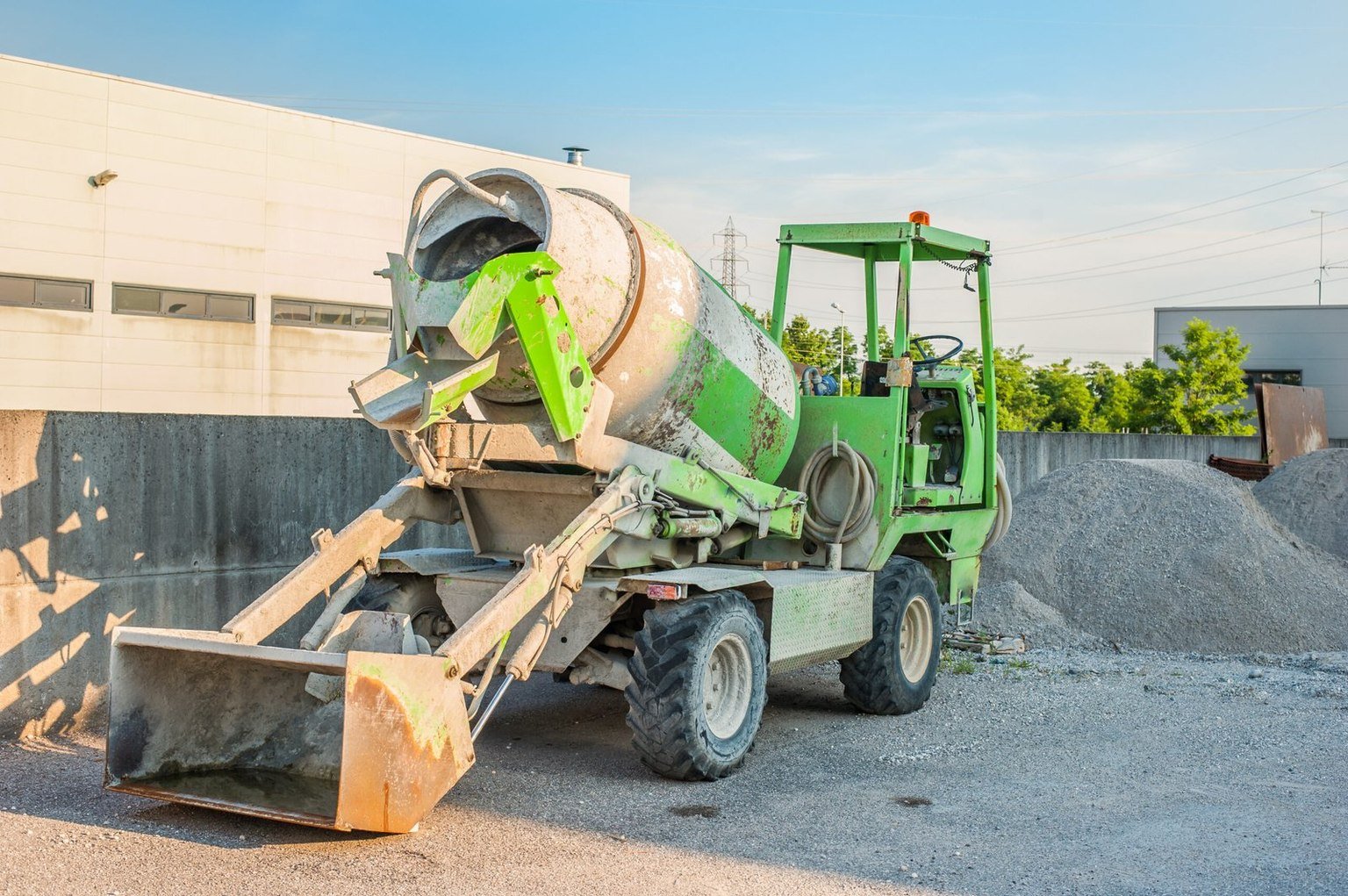
As explained in a few articles previously, concrete is the most important component of the grey structure construction of a house or building. Concrete is made by mixing cement, sand (fine aggregate) and crush (coarse aggregate) with a certain ratio of water. Concrete mixing is a very sensitive process for all grades of concrete, and the strength of the finished concrete depends heavily on the workmanship and professionalism during the mixing process.
Video guide accompanying this article.
Unfortunately, due to non-availability of locally produced, economical construction machinery and equipment, and a lack of interest by successive governments in vocational training for labor, concrete mixing has never been up to the mark on small-scale (residential and commercial) construction sites. Concrete is either mixed manually by hand, or small mixing machines are used — and since these too are not locally produced, not every labor contractor can afford to purchase his own machine. The only real option is to rent a machine on a daily basis, which is why contractors typically hire a mixing machine only for slab-pouring stages throughout the construction process.
The best recommended method for mixing concrete is by using a batching plant. Concrete mixed in a batching plant is often termed ready mix concrete. This type of concrete is ready to be poured at the construction site the moment it leaves the batching plant. A batching plant is a computer-guided facility that uses automation to make sure concrete is mixed perfectly, in whatever grade or ratio is required. Batching plants are expensive and require a decent amount of space to be assembled and made operational, along with staff to manage day-to-day operations. Due to its high capital and operational cost, the end product — ready mix concrete — is more expensive than conventional on-site concrete mixing. In this article we explain and calculate, in detail, the comparison between per-cubic-foot ready mix concrete cost and conventional concrete cost.
Let us suppose an area of 100 cubic ft & 1:2:4 ratio concrete for calculation
Wet volume of concrete = 100 cftDry volume = wet volume x 1.54 = 100 x 1.54 = 154 cubic ftSum of ratio 1:2:4 = 7
Cement in cubic ft required = 154/7 = 22 cftCement in bags required = 22/1.25 = 17.6 bagsSand in cubic ft required = 22 x 2 = 44 cftCrush in cubic ft required = 22 x 4 = 88 cftWater required approx. = 450 ltr
Now, to calculate the cost of concrete, we use latest market construction material rates as of October 2019:
Cement = 540 Rs/bagCrush (Sargodha plant) = 75 Rs/cftSand (Chenab) = 32 Rs/cftWater = Rs 0.5/ltr
Hence,
Cement = 17.6 x 540 = 9,504 RsSand = 44 x 32 = 1,408 RsCrush = 88 x 75 = 6,600 RsWater = 450 x 0.5 = 250 RsTotal = 17,762 Rs / 100 cftPer cubic ft cost of conventional concrete = 17762/100 = 177.62 Rs
Now, as per market sources that provide ready mix concrete around Lahore, the average rate of 3000 psi, 1:2:4 concrete — using the same materials as above — is around 8,000 Rs per cubic meter, as of October 2019.
Per cubic meter ready mix concrete cost = 8,000 RsPer cubic ft ready mix concrete cost = 8000/35.3 = 226.66 Rs
It is important to note here that the above costs include only the expenses incurred in making the concrete itself — material and labor for mixing. This estimate does not include the pumping cost of concrete, which stays roughly the same in both cases if concrete is poured using a local lift-and-labor system. However, ready mix concrete cost will significantly go upward if a mobile concrete pump is used instead.
| # | Method | Cost (Rs/cft) |
|---|---|---|
| 1 | Conventional on-site mixing | 177.62 |
| 2 | Ready mix concrete (batching plant) | 226.66 |
As the comparison above shows, ready mix concrete carries a higher per-cubic-foot cost, but that higher cost can save you from many other hassles involved in conventional concrete mixing, such as:
- On-site material dumping/offloading in huge quantities for cement, sand and crush, which requires extra space
- Non-stop water provision
- Approximate ratio mixing instead of accurate, automated mixing
- Hiring labor and a mixing machine for the whole process
There are, of course, some real cons to ready mix concrete too, such as:
- Higher per-cubic-ft cost
- Non-availability of a batching plant in the areas closest to your site
- Travel time from the batching plant to your site, since ready mix concrete has a working life of only 1.5-2 hours
- Access of the concrete mixer truck to your site might only be possible at night, since most cities do not allow heavy traffic entry during the day
- If your site is located in a society with narrow roads or open wires hanging on poles, it may be impossible for a concrete mixer truck to reach the site at all
It is safe to conclude that if you are willing to use ready mix concrete during the construction of your house, proper calculations are required, keeping the above pros and cons in mind. Concrete pouring is a sensitive process that must be carried out in a single go — if the total concrete quantity required for completing the slab has not been calculated properly before placing the order at the batching plant, or if the batching plant lacks the workmanship and sufficient concrete mixer trucks to meet your requirement, that slab pouring can turn into a nightmare.