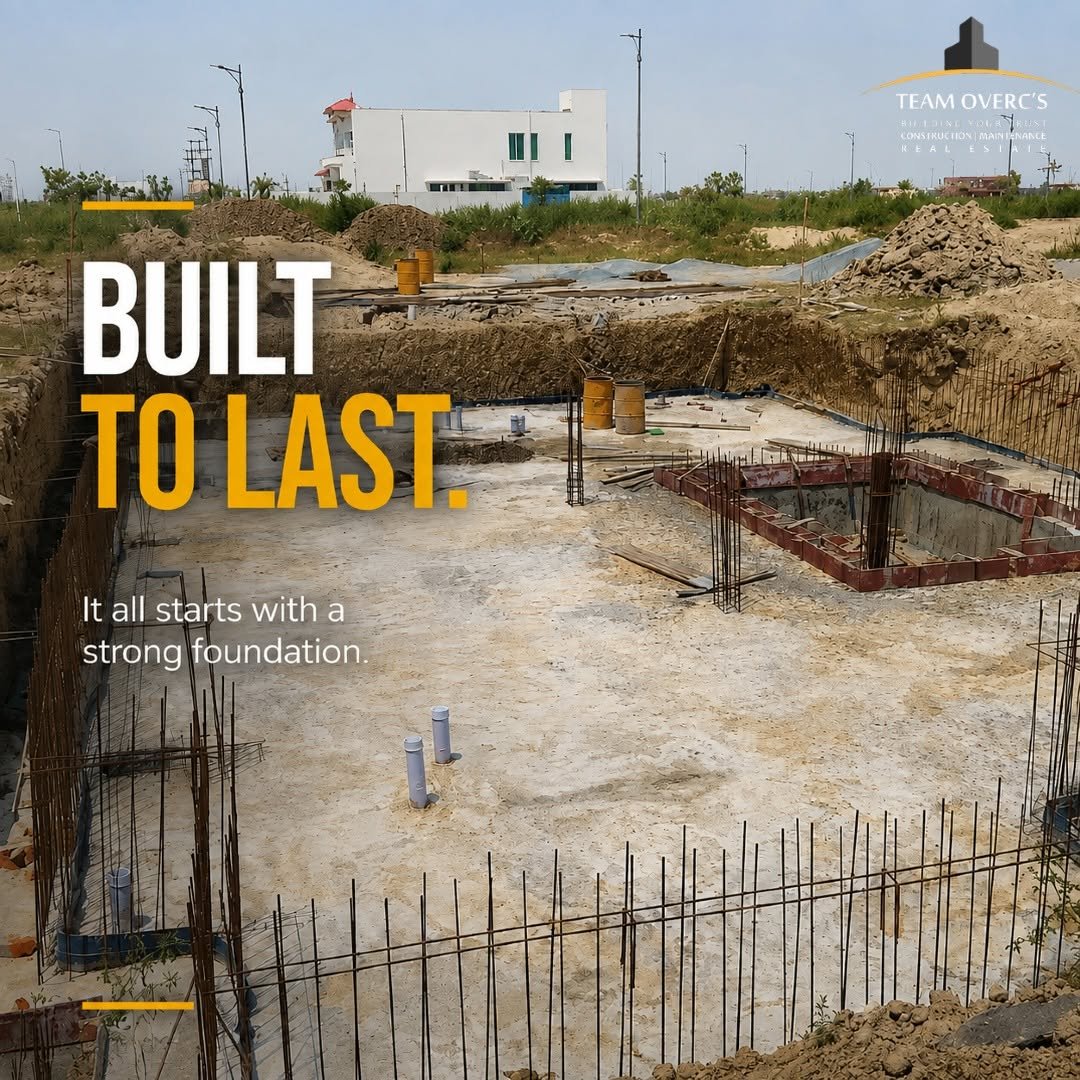
Construction Field Series Episode 3 — R.C.C basement bed. In this episode our technical staff explain what happens after the steps discussed in the last episode.
- Marking for excavation
- Excavation
- Compaction
- Basement Bed P.C.C (Plain Cement Concrete)
- Termite Proofing
Step 7 to be discussed in this episode is the R.C.C basement bed, which includes brief tutorials on each of the following:
Toe wall for holding R.C.C bed concrete
It is a temporary wall which is made using bricks or concrete blocks for holding the concrete of the R.C.C bed; other than bricks, shuttering material such as steel plates, wood planks and palai sheets can also be used to hold the concrete together.
Vapour barrier for seepage protection
This step is carried out after making the P.C.C bed and the toe wall discussed above. As the name suggests, it protects the basement from seepage, especially in areas where the water level is close to ground. The most reliable method for a vapour barrier is using PVC membrane sheets; however, due to the higher cost, an alternate and more economical method — using bitumen and a polythene sheet as the vapour barrier — is also common.
Reinforcement
Reinforcement is carried out as per the structural drawings for the basement R.C.C bed, provided by the structural engineer. There should be no compromise on reinforcement of the R.C.C bed, as it has to hold the weight of the entire retaining walls.
Water stopper PVC for joint protection
PVC water stoppers are placed at the joint of the R.C.C bed and the R.C.C retaining walls. They are most commonly available in a width of 9 inches, placed so that half (4.5 inches) sits inside the R.C.C bed during pouring and the remaining half sits in the R.C.C retaining walls — creating a barrier and protecting the joint.
Concrete pouring 1:2:4 M15
M15 concrete is composed of 1 part cement to 2 parts sand to 4 parts crush aggregate, mixed with 24 to 25 litres of water. Bed concrete should always be vibrated so the mixture blends together — better blending means more strength. After pouring, the concrete should be cured for at least 10 days to gain its full strength.
R.C.C (Reinforced Cement Concrete) structures carry a higher cost, and basements are built in R.C.C structures — which puts them out of budget for many homeowners. However, a basement brings real benefits: extra living space, more controlled temperatures in both summer and winter, and protection from outside noise and dust. Basements can be designed for complete or partial accommodation. A complete accommodation includes master bedrooms with attached washrooms along with other divisions such as a living area, store and servant room, while a partial accommodation includes only the latter divisions. Partial accommodation is recommended more often, since it avoids wet areas such as washrooms and kitchens — and therefore does not require installation and maintenance of a septic or liquid-waste disposal system.
Field Series Episode 3
Video guide accompanying this article.