Every house is incomplete without curtains, blinds or drapes. Curtains or blinds not only add style to the interior of the house, but also stop sunlight from entering the room directly. They also maintain privacy by covering the windows. Curtains are available in different sizes and materials — they can start from the top of the window and go down till they touch the floor, or an inch or two above it. We consider curtains and drapes as similar, but there is a small difference between the two. In this article we will be discussing the different types of curtain tops, hooks and loops.
Curtains
Curtains can be of different lengths — for instance small enough to just cover a window, or full length till the floor — and are made of lightweight fabric such as cotton or linen. Drapes, on the other hand, are full length from the top of the window till the floor, and are made of heavy and thick fabric like velvet, silk or organza to block sunlight from entering the room. It is therefore important to choose the right type of drape or curtain that best suits your interior theme.
Grommet Curtains
Grommet curtains are the most common type used in rooms. These curtains are more casual and simple, and have silver rings on top that go into the rod for easy movement when opening and closing. These curtains are made from medium or lightweight fabric.
Rod Pocket Curtains
A rod pocket curtain is sewn across the top of the curtain panel for the rod to cross through or be inserted into. Rod pocket curtains are also known as casement curtains. They are similar to grommet curtains, as they are also made from lightweight fabric and give a casual look.
Tab Top Curtains
Tab top curtains have loops on top for the rod to go through. These curtains do not move very easily, as the loops don't move from their place. They are therefore best for rooms or windows that are not used very often, or are not opened on a regular basis.
Pleated Drapes
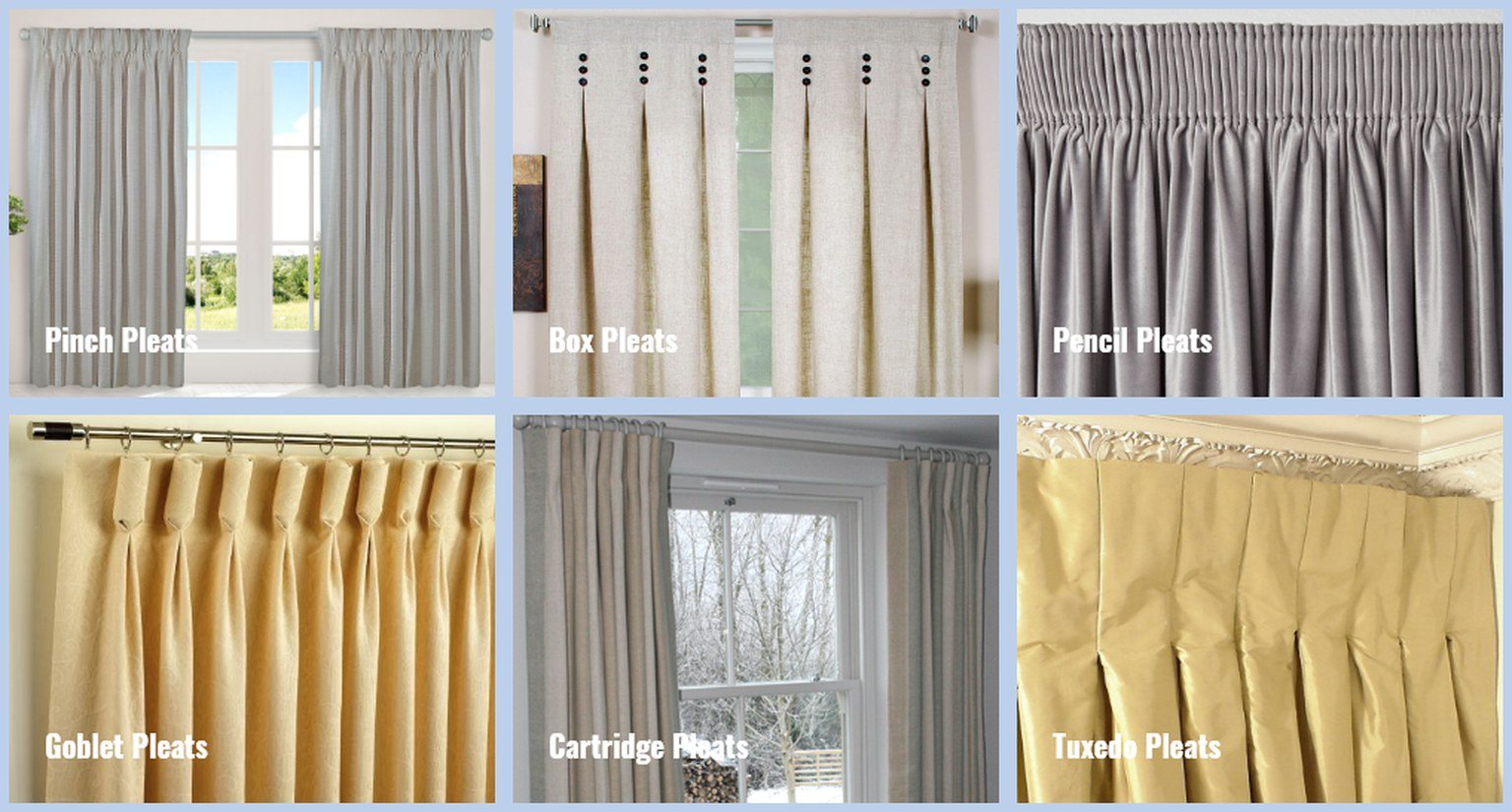
Pleated drapes are more classic and formal, giving a more formal look to the whole interior of the room or windows. The pleats are formed by a header tape sewn at the back of the curtain. After the pleats are formed, they are hung with the help of hanging hooks on rings, which then go into the rod so they can move back and forth easily. As drapes are made of heavy fabric, these pleats give a nice formal look and flow to the whole drape.
Pinch Pleat Drapes
A pinch pleat drape is a series of single, double or triple pleats that are pinched in the centre, forming a fan above and below the pinch. This is the most common type of drape used in our households, usually in the drawing and dining areas.
Pencil Pleat Drapes
Pencil pleat drapes are thin single pleats made in neat and tight folds. These are commonly used in bedrooms, and sometimes in bathrooms, to cover the window and also the bathtub.
Pelmets and Valances
Pelmets are used to make the curtain wall look more attractive and to hide curtain fixtures on top of the window. These types of drapes or curtains were widely used before, but have been replaced by more compact and smaller-topped drapes and curtains in bedrooms. However, pelmets and valances are still widely used in formal areas such as drawing rooms and dining rooms.
These were the types of curtains and drapes used in houses. It is important to know these types to make the interior of bedrooms, drawing rooms, dining rooms and even TV lounges look better. Curtains don't only cover the windows, but are an important interior factor that affects the ambiance of the house.
Calculation for a 7ft x 7ft Standard Double Layered Curtain
Layer 1: Blind
Velvet fabric required
6 metres if the fabric roll is 1.5 metres wide.
Market price per metre: Rs 450/- to 600/-. For calculation, let's consider a price of Rs 500/- per metre.
6 metres x Rs 500 = Rs 3,000/-
OR 3 metres if the fabric roll is 3 metres wide.
Market price per metre: Rs 850/- to 1,000/-. For calculation, let's consider a price of Rs 900/- per metre.
3 metres x Rs 900 = Rs 2,700/-
Motive on Blind
Laser cut price range: Rs 1,500/- to 2,500/-
Handmade price range: Rs 4,000/- to 5,000/-
OR viscose fabric — market price per metre Rs 600/- to 1,200/-. For calculation, let's consider a price of Rs 1,000/- per metre.
6 metres x Rs 1,000 = Rs 6,000/-
Note: a motive cannot be made on viscose, as it is a designed fabric.
Layer 2: Curtain
Palachi fabric required
7 metres if the fabric roll is 3 metres wide (palachi is only available 3 metres wide).
Market price per metre: Rs 450/- to 800/-. For calculation, let's consider a price of Rs 500/- per metre.
7 metres x Rs 500 = Rs 3,500/-
OR shafoon/organza fabric required — 7 metres if the fabric roll is 3 metres wide (only 3 metres wide available).
Market price per metre: Rs 450/- to 800/-. For calculation, let's consider a price of Rs 500/- per metre.
7 metres x Rs 500 = Rs 3,500/-
Other Items/Hardware Required
Stainless steel rod (8ft): Rs 500
Brackets: Rs 200
Rings or rail: Rs 100
Belt pair: Rs 500
Belt hook: Rs 200
Total: Rs 1,500
Labour for Curtain Stitching and Fixing
Rs 75 to 100 per sqft. Total sqft in a 7ft x 7ft curtain = 7 x 7 = 49 sqft.
Total labour cost = 49 x Rs 100 = Rs 4,900
Cost Summary
| # | Item | Cost (Rs) |
|---|---|---|
| 1 | Layer 1 blind in velvet | 3,000 |
| 2 | Motive, laser cut printed | 2,500 |
| 3 | Layer 2 curtain in palachi | 3,500 |
| 4 | Hardware & other items | 1,500 |
| 5 | Labour for stitching & fixing | 4,900 |
| Total cost of double layered 7ft x 7ft curtain | 15,400 |