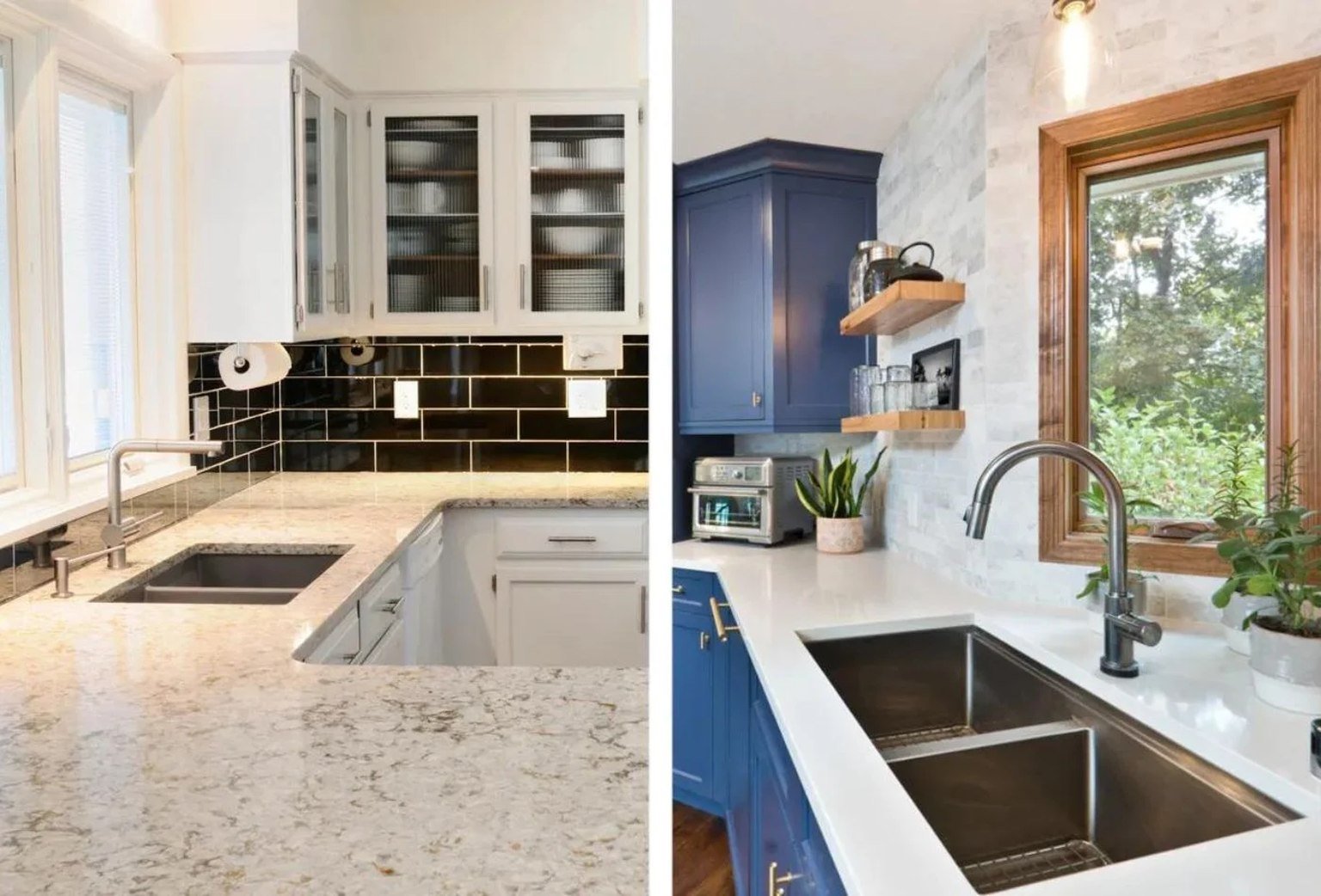
One of the toughest decisions you will have to make while finishing your kitchen and bathrooms is whether to use a Corean top or a granite top. There are several factors worth keeping in mind while making that decision.
Difference between Corean top and Granite top
First, it is important to know what these two materials actually are, and what they are made of. Corean has gained popularity in recent years as a solid-surface countertop material. It was first manufactured roughly half a century ago, but wasn't widely used until much more recently. Corean is a mixture of different minerals — such as ground granite — and plastic resins. Its manufacturing process is fairly simple: all its ingredients are mixed together and heated, then set in a mould to cool off. Corean can be made in a wide range of shapes and sizes as required.
Granite, on the contrary, is a completely natural material. It is excavated directly from mountains, then sliced into slabs and polished — nothing is added to it, and nothing is removed from it beyond the cutting and polishing itself. The main difference between the two is that one is manufactured from a blend of different materials, while the other is extracted from quarries naturally and simply polished. Corean has a sleeker, more uniform look, whereas granite is harder and tougher. Granite is usually used for kitchen countertops, vanity tops, stairs and entrance steps, while Corean is used for kitchen tops, vanity tops and in wall niches — it cannot be used on stairs, as it is not as hard and durable as granite.
Cost
Corean has become the pick of the day recently, mainly because it is easy to customise into different shapes and sizes according to taste, and can be carved into more exclusive layouts than granite allows. Even though a Corean top is generally more expensive than the granite typically used in house construction, it is often preferred for its range of shapes, sizes and colours. Corean can cost around Rs 1,300 per sq.ft and up, and is used on kitchen counters, bathroom vanity tops, and in wall niches around the house. Granite is far more durable, made for tougher day-to-day conditions, and can be used on kitchen counters, vanity tops and stairs. Granite can be purchased from around Rs 300 per sq.ft and go up beyond Rs 1,500 per sq.ft for exclusive slabs — though a normal granite slab typically used on kitchen counters and stairs generally ranges from Rs 500 to Rs 1,000 per sq.ft.
Appearance
It is genuinely difficult to say which looks better between Corean and granite. Some prefer the rock-solid look of granite, with its natural stone texture and deep lustre, but people often don't want their kitchen top or bathroom vanity to look overly busy with that natural texture. Others may prefer the plainer, smoother and sleeker look of Corean, which is easier on the eye. Granite's deep, coloured texture can also hide crumbs and smears better than Corean can. Compared to granite, Corean looks a little more synthetic — it lacks the natural shine of granite, but offers a plainer surface with no visible joints. Granite is only available in certain fixed slab sizes, whereas Corean can be tailor-made to almost any size.
Durability
Granite requires sealing every couple of years to keep it stain-free — it can be stained by oil and other acidic materials, such as lemon juice or vinegar — whereas Corean has no such chemical vulnerabilities. Both materials are hygienic surfaces and are easy to keep clean, and both are otherwise very rock-solid and durable. When it comes to heat resistance, granite wins by a fair margin — you can carelessly set a hot pan on granite without any worries, but you cannot do the same with Corean, which can get scorched by direct contact with a hot pan.
We hope this article helps you make the right decision for your own kitchen counters or vanity tops.